How to Measure a Baby's Heart Rate
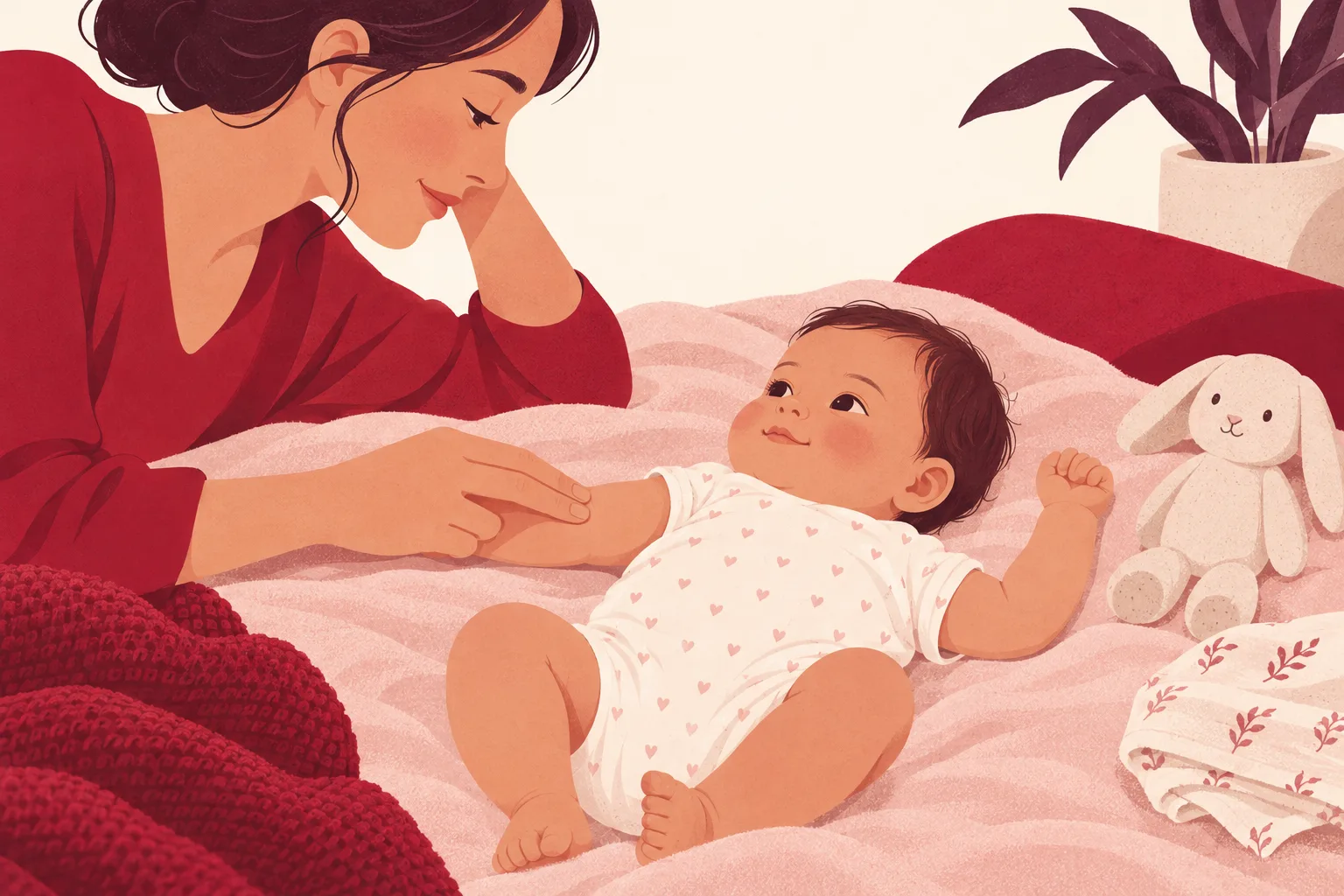
A baby's heart beats much faster than yours — 100 to 160 times a minute is typical for an awake infant. Here is where to find the pulse, how to count it and what the numbers mean.
Where to feel a baby's pulse
- Inside of the upper arm (brachial pulse) — the best spot for babies under one year. Lay the baby on their back, turn the arm outward, and press two fingertips gently on the inner side of the upper arm, between elbow and shoulder.
- Groin (femoral pulse) — in the crease where the leg meets the body, midway between hip bone and pubic bone.
- Chest — place your hand or a stethoscope on the left side of the chest and count the heartbeats directly. Easiest for many parents.
- Wrist and neck — work well in older children, but are hard to find in babies because of the short neck and small wrists.
Use your index and middle fingers, never your thumb — your thumb has its own pulse that you might count by mistake.
How to count
- Measure when your baby is calm and awake, or sleeping — and note which. Crying, feeding and fever all raise the rate.
- Count the beats for a full 60 seconds. Babies' heart rates naturally speed up and slow down with breathing, so short counts are less accurate. If that is not possible, count 30 seconds and double it.
- Repeat once or twice and write down the numbers with the time and what the baby was doing.
Normal heart rate by age
| Age | Normal heart rate (awake, calm) |
|---|---|
| Newborn (0–1 month) | 100–190 bpm* |
| Infant (1–11 months) | 80–160 bpm |
| Toddler (1–2 years) | 80–130 bpm |
| Preschool (3–4 years) | 80–120 bpm |
| Child (5–6 years) | 75–115 bpm |
| Child (7–9 years) | 70–110 bpm |
| 10 years and older | 60–100 bpm |
Source: NIH MedlinePlus. While asleep, rates are often 10–20 bpm lower; while crying, they can briefly reach 180–200 in a young baby.
* Newborns: MedlinePlus lists 70–190 bpm. We use 100 as the lower limit, because in a newborn a heart rate below 100 needs prompt medical assessment (newborn resuscitation guidance treats under 100 as bradycardia).
Look up a specific reading: 110, 140 or 170 bpm in a child.
When to call the doctor
- Call 911 (US) or your local emergency number if the heart rate is below 60 and the baby seems unwell, or if a baby has trouble breathing, turns blue or grey, or is very hard to wake.
- Get a newborn checked promptly (first month of life) if the heart rate is below 100 when calm and awake.
- Seek urgent care if a calm baby's heart rate is above 220, or if it suddenly jumps very high and stays there — that can be supraventricular tachycardia (SVT). Signs in babies include poor feeding, sweating, fast breathing, pale skin and unusual sleepiness or fussiness.
- See your pediatrician if repeated calm measurements are outside the normal range for your baby's age, or if the beat seems irregular beyond the normal speeding-up and slowing-down with breathing.
More: Why Infants Have a Faster Heart Rate Than Adults · Fast, Slow or Irregular Heart Rate in a Child
Sources: MedlinePlus: Pulse · AHA 2020 guidelines, neonatal resuscitation · AHA 2020 guidelines, pediatric life support
Check a heart rate
Related guides
- Why Infants Have a Faster Heart Rate Than Adults
- Fast, Slow or Irregular Heart Rate in a Child
- The Human Heart Rate: What Is Normal and What Changes It
- Resting Heart Rate: What It Says About Your Health
This page offers general information, not medical advice. If your heart rate worries you, please talk to a doctor. In an emergency, call 911 (US) or your local emergency number.